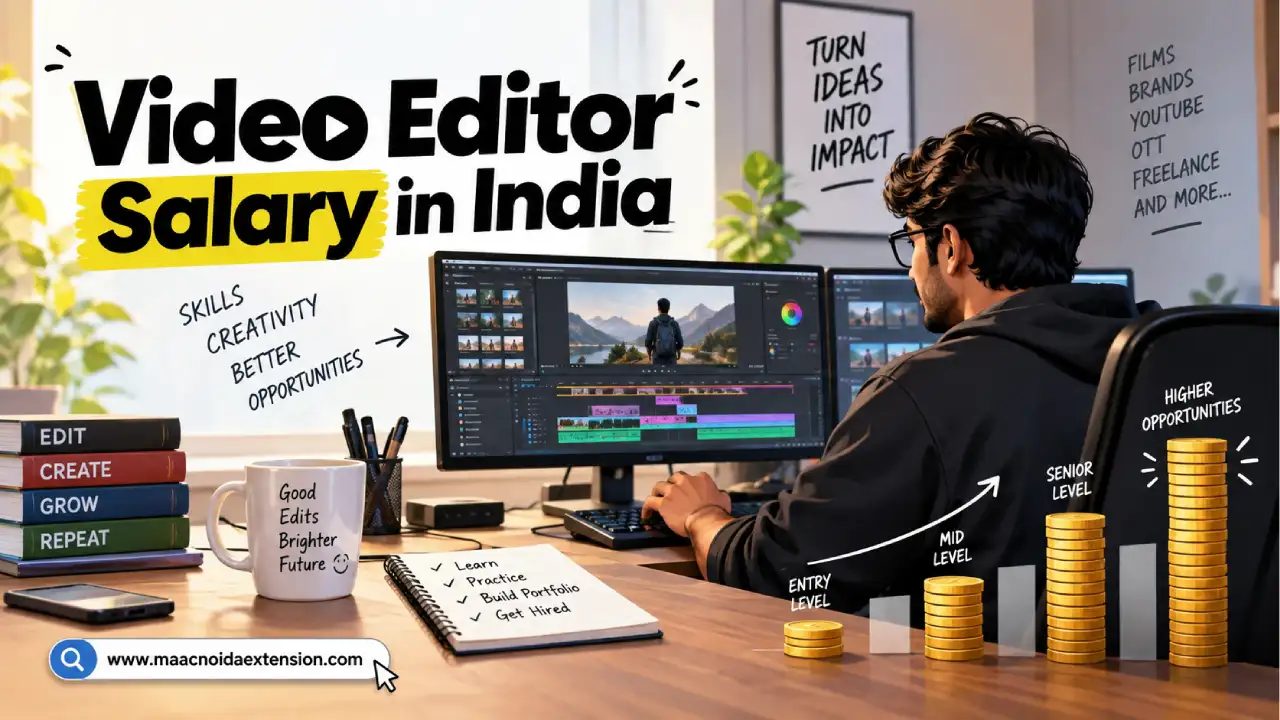
According to Indeed India, the average monthly salary for a video editor in India is about ₹18,575, based on data from May 2026 and around 1,300 reported salaries. If you’re a fresher, you can expect to start with a salary between ₹10,000 and ₹18,000. PayScale (2026) shows that the annual average for a film or video editor is ₹4,26,891, which can rise to ₹14,73,953 for those in the later stages of their careers. Your earnings will largely depend on your location, your motion graphics skills, and how quickly you can turn around projects.
What is the average video editor salary in India in 2026?
As of May 25, 2026, Indeed India reveals that the average monthly salary is around ₹18,575, based on approximately 1,300 reported salaries. Most salaries fall between ₹10,009 and ₹34,472. According to PayScale (2026), the annual average for a film or video editor is ₹4,26,891, with base salaries ranging from ₹1.64 lakh to ₹9.53 lakh.
What is the video editor salary in India for freshers?
As a newcomer to video editing in India, you can typically expect to earn between ₹10,000 and ₹18,000 a month. This figure reflects the lower end of the salary range noted by Indeed India in May 2026. In your initial role, creative control might be a bit limited. For the first six months, your tasks will mostly involve syncing audio, trimming subtitles, correcting exports, and organizing timelines that have been set up by others.
Those months build the habit employers pay for, which is reliability. In our experience with students from Greater Noida West who join agencies around Sector 62 and Sector 63, the ones who start at the bottom of that band and never miss a delivery date move up within the same band inside eight to ten months. The ones with a stronger showreel and slow turnaround stay where they started.
If your family is considering this investment, take a look at the video editing course fees and compare them to the first-year salary mentioned above. This way, you can figure out the payback period for yourself.
How does a video editor salary in India change with experience?
Video editor salary in India by experience rises steeply in the first three years, then flattens until you specialise. Here is how the bands usually run in Indian agencies and production houses.
0 to 1 year: ₹10,000 to ₹18,000 a month in junior and assistant editor roles.
1 to 3 years: ₹18,000 to ₹30,000 a month once you own a timeline from rushes to final export.
3 to 5 years: around the PayScale (2026) annual average of ₹4,26,891, higher with motion graphics.
8 years and above: PayScale (2026) puts the late-career average at ₹14,73,953 a year, usually with supervision duties or a narrow specialisation attached.
Our best advice? Think about making a job change around the eighteen-month mark. In smaller studios, promotions are usually pretty limited, but switching things up at this point can give your career a fresh start. If you wait three years, hoping that loyalty will pay off, you might find that your next employer is more interested in your old salary than what you can bring to the table now. Knowing the wider range of video editing roles available for beginners can shed light on what opportunities arise at each stage of your career.
Which cities pay the highest video editor salary in India?
According to Indeed India (May 2026), video editors in Mumbai are earning around ₹66,801 a month, while those in Noida and Bengaluru are making ₹25,749 and ₹25,040, respectively. It’s worth noting that the Mumbai figure is nearly four times the national average, so let’s break that down before anyone considers relocating.
This high number primarily comes from the film and OTT post-production jobs that are concentrated in Mumbai, where salaries for experienced professionals are significantly higher. However, a newcomer in Andheri can expect a salary much closer to the national average. We’ve seen students mention a city average during their first interviews, only to lose the opportunity because of it, so it’s important to view any city salary as a mix of different experience levels.
For the Delhi NCR region, the Noida figure is a more realistic standard. The local rate is influenced by corporate films, ad agency projects, and creator content across Noida, Greater Noida West, and Gurugram, which is the market that students from our video editing course in Delhi NCR are stepping into.
Which video editing job pays the most in India?
At the senior level, studio and OTT post-production roles usually offer the best pay. But for those in the early stages of their careers, agency work tends to provide a more reliable income during the first two years. Studio positions can be lucrative, but they often involve long hours and several rounds of revisions before a project gets the green light. In contrast, while agency salaries might not be as high, they come in consistently every month, which is really important when you’re managing course repayments or taking care of your family.
Course Type
Best For
How Long It Takes
Things to Check
Agency in-house editor
Freshers wanting steady monthly pay
6 to 12 months of training
Whether motion graphics is part of the role
Studio or OTT post-production
Editors ready for long shifts and reviews
2 to 3 years of prior work
Whether you get a credit on delivered projects
Freelance with retainers
Editors with a delivery record
1 to 2 years plus a portfolio
Payment terms and revision limits, in writing
Creator-side editor
Fast short-form editors
3 to 6 months plus sample cuts
Whether monthly output volume is fixed
If you are choosing between these, pick the one that gives you finished work you can show. A video editing course with live projects does the same thing before you ever sit in an interview.
How much does a freelance video editor earn in India?
When it comes to freelance video editor salaries in India, there really isn’t a solid average out there—most numbers you hear are just educated guesses. Your income as a freelancer can fluctuate based on how many clients you have, the terms of your retainers, and how many rounds of revisions you’re willing to take on. Generally, having two clients on monthly retainers tends to be more profitable than juggling six one-off projects, since those one-off clients often require a lot of follow-up for payments.
Take, for example, a student we advised who was editing from a tier 2 city in Uttar Pradesh while finishing his degree. He picked up work from a local gym and a couple of coaching institutes. Initially, his per-video rate seemed quite promising, but once he started offering unlimited revisions, each project ended up taking an extra three days to complete. By setting a limit of two revision rounds in writing, he significantly boosted his monthly earnings—more so than if he had simply raised his rates.
For anyone just starting out, we suggest sticking with a salaried job for the first couple of years while freelancing on the weekends. Those cash flow gaps can be tough for beginners, often more so than dealing with lower rates.
Which skills raise a video editor salary the fastest?
Pay rises when you can handle the stage after the cut. Motion graphics in After Effects is the single biggest jump for an editor in Delhi NCR, because agencies bill it as a separate line item. Colour grading in DaVinci Resolve comes next, then clean audio work in Audition. Speed sits alongside all three. An editor who turns a forty-minute podcast into eight short-form cuts within two days is priced differently from one who only assembles long-form.
The Media and Entertainment Skills Council, set up under NSDC, publishes NSQF-aligned qualification packs that spell out what each media job role is expected to deliver. Read the relevant one when a job description looks vague. On the demand side, the Union Cabinet has approved a National Centre of Excellence for AVGC-XR in Mumbai, with FICCI and CII as industry partners, which points towards more structured studio hiring over the next few years.
We tell students in our Premiere Pro video editing batches to finish their editing fundamentals first and add After Effects afterwards. Learning both in the same three months usually means doing neither well enough to charge for.
How do you become a video editor in India and start earning?
Follow these steps in order. Each one produces something you can show an employer.
Choose one editing software and learn it fully before touching a second.
Edit ten real videos for local businesses, unpaid if needed, to build proof.
Add After Effects only after your cuts and exports are consistently clean.
Publish three finished pieces online with the raw footage alongside them.
Apply to agencies and production houses in your own city first.
Renegotiate pay after twelve months using delivered work as evidence.
Students who cannot attend daily classes often start with an online video editing course with certificate and shift to a centre once they know the software holds their interest.
What should you do first to earn a higher video editor salary?
This week, pick one software, finish three complete edits using real footage, and upload them somewhere a hiring manager can access with just one click. Those three pieces will do more for your chances of landing that first job than any salary chart on this page. Once they’re ready, compare them to what agencies in Noida and Delhi NCR are currently offering and work on closing any gaps you find.
If you want that gap closed with structured training, live projects, and portfolio review, fill in the enquiry form on our video editing course in Noida Extension page or call the centre to discuss a batch that fits your college schedule.
What is the video editor salary in India per month?
Indeed India (May 2026) reports an average of ₹18,575 a month for video editors, with most reported salaries falling between ₹10,009 and ₹34,472 depending on experience, city and the type of employer.
What is the starting salary of a video editor in India?
A fresher video editor in India usually starts between ₹10,000 and ₹18,000 a month. Agencies in Noida, Gurugram and Bengaluru pay near the middle of that band when the candidate already has a working portfolio.
What is the senior video editor salary in India?
PayScale (2026) reports an average of ₹4,82,652 a year for a senior video editor in India, with base pay running up to about ₹9.93 lakh. Late-career film and video editors average ₹14,73,953 a year.
Can a video editor earn one lakh per month in India?
Yes, but not early. Editors reaching that level usually hold eight or more years of experience, supervise a team, or run a freelance practice with several retainer clients and a specialisation like motion graphics.
Which city pays video editors the most in India?
Mumbai reports the highest average at ₹66,801 a month (Indeed India, May 2026), largely because film and OTT post-production roles sit there. Noida follows at ₹25,749 and Bengaluru at ₹25,040.
Himanshu is an SEO and content strategy specialist with 10+ years of hands-on experience in Technical SEO, primarily within the EdTech industry. At MAAC Noida Extension, he focuses on building search-first content that connects students with the right career opportunities in animation, VFX, filmmaking, and design.