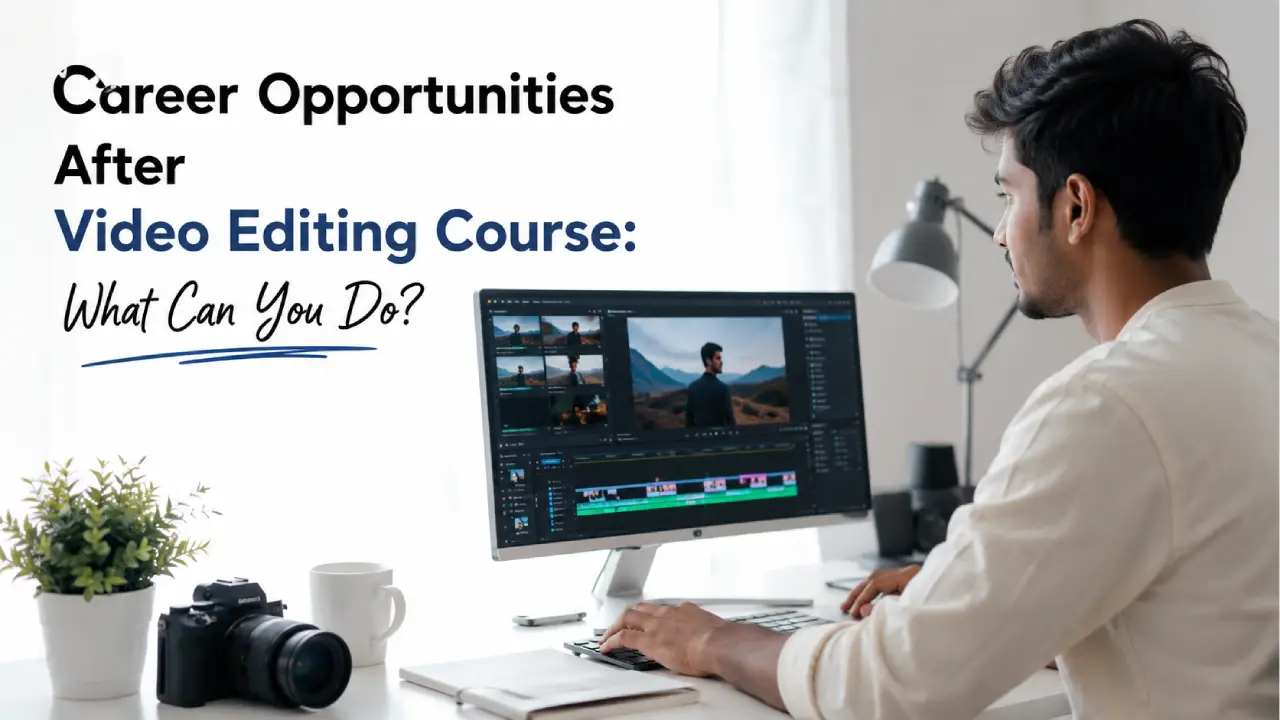
Career opportunities after a video editing course include work as a video editor, social media or short-form editor, motion graphics artist, assistant editor at a post-production house, and colourist. Most freshers in Delhi-NCR start at between ₹15,000 and ₹28,000 per month. Your showreel decides the offer far more than your certificate does.
I have sat through enough counselling sessions to know the real question behind this search. You are not asking which job titles exist. You are asking whether this course will actually get you paid, and how soon. So here is the answer in plain terms, with numbers, and without the usual institute talk.
What jobs can you get after a video editing course?
After a video editing course you can apply for roles like social media editor, in-house brand editor, motion graphics artist, assistant editor, colourist and wedding film editor. Entry into every one of them depends on three to five finished pieces you can show. Course length matters much less than most students assume.
Job role
What the day actually looks like
Fresher pay in Delhi NCR (per month)
Social media / short-form editor
Cutting Reels, Shorts and YouTube videos. Four to eight deliverables a week, quick turnarounds.
₹15,000 to ₹25,000
In-house video editor
One brand, mixed work: ads, testimonials, product films, event recaps.
₹18,000 to ₹30,000
Motion graphics artist
Titles, lower thirds, animated explainers, logo stings in After Effects.
₹22,000 to ₹40,000
Assistant editor
Ingest, sync, logging, rough cuts, backups. Unglamorous and very good training.
₹15,000 to ₹22,000
Colourist / DI assistant
Grading in DaVinci Resolve, matching shots across a timeline.
₹20,000 to ₹35,000
Wedding and event film editor
Highlight cuts, teasers, full films. Heavy season, quiet monsoon.
₹18,000 to ₹35,000, often per project
Freelance editor
Your own clients, your own deadlines, your own invoices.
Varies widely, see the freelance section
What I would tell you to do: go after the social media editor role first, even though it pays the least on this list. It gives you volume. Forty finished Reels in six months builds a stronger portfolio than four months of syncing audio on someone else’s project. If you want the full list of job options and growth paths in video editing, we have covered that separately.
How much do video editors actually earn in India?
Video editors in India earn roughly ₹15,000 to ₹30,000 a month as freshers, and ₹35,000 to ₹70,000 with 3 to 5 years of experience. Indeed’s salary data shows a monthly average close to ₹18,500, with most reported figures sitting between ₹10,000 and ₹35,000.
Stage
Experience
Monthly pay in Delhi NCR
What changes at this stage
Trainee/intern
0 to 6 months
₹8,000 to ₹14,000
You are being paid to learn the pipeline. Take it if the work is real.
Junior editor
6 months to 2 years
₹15,000 to ₹28,000
Speed and reliability matter more than taste. Volume builds the reel.
Mid-level editor
2 to 5 years
₹30,000 to ₹58,000
You start owning projects. Motion graphics or grading usually enters here.
Senior editor
5 to 8 years
₹60,000 to ₹1.2 lakh
You are hired for judgement, not for keystrokes. Some people also lead a small team.
Freelance, established
3 years and up
Highly variable
Retainers with two or three steady clients beat chasing one-off projects.
A student finishes a video editing course and joins an ed-tech company in Sector 63 at ₹16,000, editing lecture videos. Repetitive work, honestly. But in eleven months he has cut more than 300 videos, survived three launch weeks, and taught himself After Effects on Sundays. The next offer is ₹34,000. The jump did not come from the certificate. It came from volume plus one extra skill. If you are still comparing options, our breakdown of video editing course fees and what is included is worth ten minutes.
Which industries in Delhi NCR hire video editors?
India’s media and entertainment sector grew 9% to ₹2.78 trillion in 2025, and digital media crossed ₹1 trillion to become the largest segment for the first time, according to the FICCI-EY 2026 report. That number matters to you for one reason. The money moved to formats that need editing every single week.
In Delhi NCR specifically, the hiring sits in five clusters:
News and broadcast in Noida Film City. Sector 16A has most of the national news channels, and they hire editors year-round. The pay is average, the training is brutal, and nothing teaches speed like a daily news cut.
Ed-tech and SaaS in Noida Sector 62, 63 and 132. Lecture edits, product demos, webinar cutdowns. Steady work and reasonable hours.
Agencies and D2C brands in Gurugram. Higher pay, higher expectations, and they will ask for motion graphics in the interview.
Wedding studios across Rohini, Pitampura, Ghaziabad and Greater Noida West. Seasonal, project-based, and cash-good if you can cut a teaser that makes the family cry.
Corporate video and event AV teams, plus the gaming and esports studios that have grown around Noida and Gurugram.
My recommendation for the first two years: apply to a news channel or an agency even if the offer looks unremarkable. Both put you under deadline pressure daily, which is the one thing self-study cannot simulate. Students who want to sit closer to the broadcast side often pair editing with our broadcast course in Noida Extension, while those aiming at ad films look at VFX training or the filmmaking course instead.
Should you take a job or go freelance after a video editing course?
Take a salaried job first if you have no clients, no savings and no portfolio. Go freelance first only if you already have paying work coming in. Roughly eight out of ten students I speak to are in the first group, and they lose six months finding that out the hard way.
What you are comparing
Salaried job
Freelance from day one
Money in month one
Predictable, low
Often zero
Learning speed
Fast, because mentors correct you
Slow, because nobody corrects you
Portfolio growth
Steady, but the brand owns the work
Uneven, though the work is yours to show
Ceiling after 3 years
₹40,000 to ₹60,000 a month
₹30,000 to ₹1.5 lakh, depending on your client list
What it really demands
Turning up and taking feedback
Selling, quoting, following up on payments
How do you get your first video editing job in Delhi NCR?
Getting hired as a fresher comes down to five things: a short showreel, three spec projects, a portfolio link that opens on mobile, applications sent where competition is thin, and direct messages to creators. Most students do the first and skip the rest.
Cut a 60 to 90 second showreel. Best work in the first eight seconds. No slow logo intro, nobody watches those.
Make three spec pieces. Re-edit a brand’s existing ad, cut a podcast clip into a Reel, and build a 30 second product film using stock footage. Spec work is completely acceptable at fresher level.
Put everything on one page with a Google Drive fallback link. Recruiters open these on phones between meetings. If it buffers, you are out.
Apply where nobody else applies. Everyone mails the big agencies. Very few mail the twenty-person production house in Lajpat Nagar or the wedding studio in Indirapuram, and those places actually reply.
Message creators directly. Find ten YouTube channels between 20,000 and 200,000 subscribers, watch their last video properly, and send one specific observation plus a sample cut. Ten thoughtful messages beat a hundred copy-paste ones.
Say yes to the first offer that teaches you something, even at ₹15,000. Your second job is where the money starts.
One more thing students forget: ask the institute what its placement process actually involves before you enrol. You can look at our placement support and hiring partners and judge for yourself.
Which skills raise a video editor’s pay the fastest?
Motion graphics in After Effects raises fresher pay faster than any other skill, usually by ₹8,000 to ₹15,000 a month once you can deliver clean animated titles and explainers. Colour grading comes second. Everything else compounds slowly.
Skill
Time to become employable
Effect on what you can charge
After Effects motion graphics
2 to 3 months of daily practice
Biggest single jump, often ₹8,000 to ₹15,000 a month
Colour grading in DaVinci Resolve
6 to 8 weeks
Adds roughly ₹3,000 to ₹8,000, more in ad film work
Audio cleanup and mixing
About 2 weeks
Small on paper, but it is why clients come back
Story sense and pacing
Ongoing, years honestly
Moves you from operator to editor, which is where real money sits
Saves hours per project. Lets you take on more work, not charge more
Turnaround discipline
A habit, not a course
The actual reason editors get retained
If you can only pick one thing to learn next, pick After Effects. Premiere gets you the job and After Effects gets you the raise. Students usually build this on top of a Premiere Pro course; if you are based in Noida, the Adobe Premiere Pro training in Noida covers the same ground with lab time. Working professionals who cannot attend regular batches sometimes start with an online video editing course and shift to the classroom later.
Where does this career go after five years?
Five years in, most editors land in one of four places: senior editor at a company, post-production supervisor, freelance editor with retainer clients, or owner of a small studio. A smaller group moves sideways into VFX, direction or content strategy.
Path
What it looks like
Realistic income at year 5
Senior editor, in-house
Owning the video output of one brand, sometimes leading a junior
₹8 lakh to ₹14 lakh a year
Post-production supervisor
Managing timelines, editors and delivery for multiple projects
₹10 lakh to ₹18 lakh a year
Freelance with retainers
Two or three steady clients plus project work
₹6 lakh to ₹20 lakh, uneven month to month
Small studio owner
You edit less and sell more. Different job, honestly.
Depends entirely on your client list
Sideways into VFX or direction
Compositing, grading or directing branded content
₹7 lakh to ₹15 lakh a year
Pick your direction around year three, not year one. Before that you do not have enough information about what you enjoy. Students in the Delhi and NCR region who want the broader picture of video editing career scope in Delhi can compare course tracks there.
Will AI take video editing jobs?
Every second student asks me this, so let me answer it straight instead of hiding behind reassurance.
AI has already taken the boring part. Auto subtitles, silence removal, rough assembly, background noise cleanup, all of that is close to free now, and it is not coming back. If your plan was to earn a living by trimming dead air, that plan is finished.
What AI has not taken is judgement. Knowing that a cut lands two frames late. Knowing the client will hate the third option but ask for it anyway. Knowing when to hold a shot for one extra beat because the moment needs air. Those are still human calls, and the editors I know who use AI tools well are simply delivering more work per week, not fewer.
Am I fully relaxed about it? No. I think the bottom rung of this ladder is getting thinner, which makes it more important that your first two years produce a real portfolio and not just a certificate. Learn the tools that automate your grunt work, then spend the time you save on the parts that need taste.
Final Thoughts
A video editing course can open doors to jobs in YouTube, advertising, social media, films, and digital content. But the course alone won’t build your career. Your portfolio, practical skills, and ability to keep learning will matter just as much.
If you’re serious about becoming a video editor, start building real projects alongside your course and explore the career path that fits your interests best. You can reach the Noida Extension centre here.
FAQs
Is video editing a good career in India in 2026?
Yes, mainly because demand comes from brands and creators rather than only from film. Digital media is now the largest segment of India’s media industry. Pay starts modest, but growth is quick for editors who add motion graphics.
What is the starting salary after a video editing course?
Freshers in Delhi NCR usually start between ₹15,000 and ₹28,000 a month. Interns start lower. Your portfolio, software range and turnaround speed decide where you land inside that band.
Can I get a video editing job without a degree?
Yes. Studios and brands hire on showreels, not degrees. A diploma or certificate helps you get shortlisted and gives you structured practice, but the hiring decision comes down to the work you can show.
How long does it take to get a job after a video editing course?
Most students who apply seriously find their first paid role within two to four months of finishing. Those who wait for the perfect portfolio take much longer. Start applying while you are still learning.
Which software should I learn first?
Start with Adobe Premiere Pro, since most Indian studios and brands run on it. Add After Effects next for motion graphics, and DaVinci Resolve after that if colour grading interests you.
Himanshu is an SEO and content strategy specialist with 10+ years of hands-on experience in Technical SEO, primarily within the EdTech industry. At MAAC Noida Extension, he focuses on building search-first content that connects students with the right career opportunities in animation, VFX, filmmaking, and design.