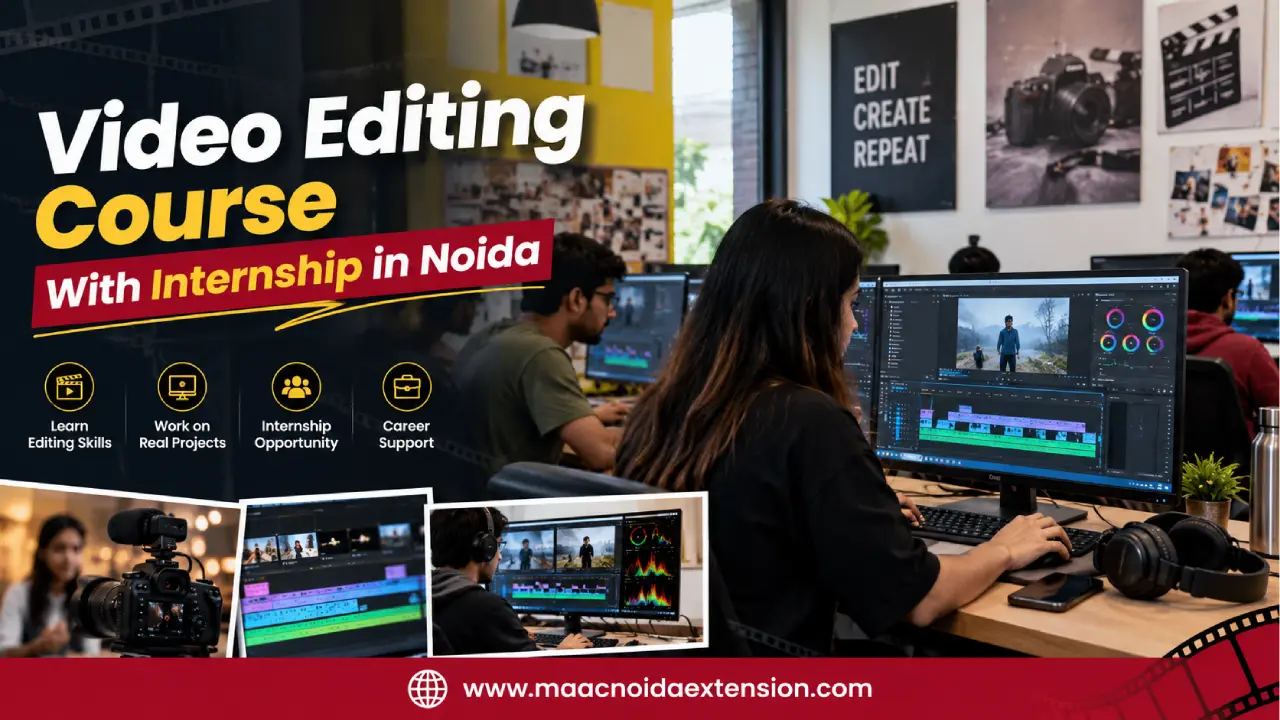
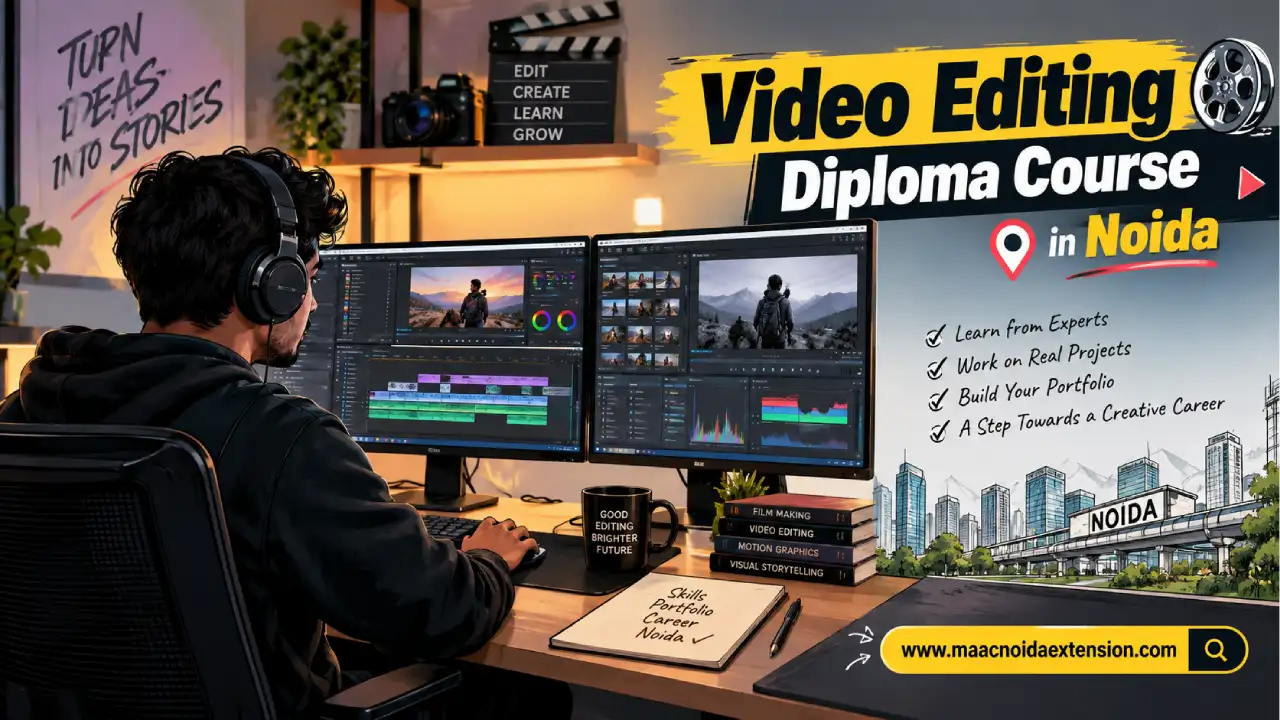
A video editing course with live projects trains you on real briefs, real footage and real deadlines instead of only sample files. You learn ingest, rough cut, sound, colour, motion graphics and delivery, then finish with four to six portfolio-ready pieces. That portfolio is what gets you hired.
Most course pages tell you which software you will learn. Very few tell you what you will have made by the end. That gap is the whole point of this article, because a hiring manager in Noida or Gurugram is not going to open your syllabus. He is going to open your work and decide in about forty seconds.
What does a video editing course with live projects actually mean?
A video editing course with live projects gives you real client briefs, unsorted footage and fixed delivery dates during the course itself. You handle the messy parts: bad audio, missing shots, a client who changes his mind on day nine. Practice exercises on clean sample files do not count.
What you get
Classroom-only training
Live project training
Footage
Pre-sorted, clean, chosen to work
Whatever the shoot produced, gaps included
Brief
Follow the instructor’s steps
A client wants something and cannot always describe it
Deadline
Submit whenever the module ends
Fixed date, because someone is waiting
Feedback
Marks or a grade
Revisions, sometimes three rounds of them
What you keep
Practice files nobody will watch
Finished work you can put in a portfolio
Here is the part nobody says out loud. A lot of institutes relabel their practice assignments as live projects. You can spot the difference with one question: who receives the final file? If the answer is your instructor, it is an assignment. If the answer is a brand, a creator, an NGO or an in-house team, it is a live project.
What I would tell you to do before enrolling anywhere, including with us: ask to see three student projects from the last batch, and ask who the client was. Any honest centre can show you that in five minutes. You can compare our video editing course in Noida Extension against that same standard.
What will you actually learn in a video editing course with live projects?
You learn the full post-production chain: media ingest and organisation, rough cut and story order, edit craft in Premiere Pro, sound cleanup, colour correction, motion graphics in After Effects, and export settings for each platform. Live projects add two more skills: reading a brief and surviving revisions.
Stage
What you do
What you walk away with
Ingest and organisation
Transfer cards, back up twice, label bins, sync audio to video
A project file another editor could open and understand
Story and rough cut
Watch everything, pick the usable takes, build the spine of the edit
Judgement about what to keep and what to lose
Edit craft in Premiere Pro
Trimming, pacing, J and L cuts, multicam, B-roll placement
Cuts that feel invisible instead of clever
Sound
Noise removal, level matching, music beds, ducking under voice
The skill most freshers ignore and most clients notice
Colour
Correction first, then grading, then matching shots across a scene
Footage from three cameras that looks like one shoot
Motion graphics
Titles, lower thirds, animated explainers, logo stings in After Effects
The single biggest earning add-on early in your career
Delivery
Export presets for Instagram, YouTube, broadcast and client review
No more rejected files at the last step
Client handling
Reading a brief, sending cuts for approval, taking revisions without ego
The reason some editors get repeat work and others do not
What kind of live projects do students actually work on?
Typical live projects include short brand films, Instagram Reels for local businesses, YouTube podcast cutdowns, wedding teasers, corporate testimonials and event aftermovies. Each has a different rhythm and a different delivery spec, which is exactly why working across formats matters more than repeating one.
Project type
What makes it hard
What it proves to a recruiter
30 second brand reel
Every frame has to earn its place
You can cut tight and follow a brief
Instagram Reels for a local business
Volume and turnaround, often six a week
You can work fast without falling apart
Podcast or interview cutdown
Two hours of footage, ten usable minutes
You have story judgement, not just software skill
Wedding teaser
Emotion, music sync, family expectations
You can carry a mood across ninety seconds
Corporate testimonial
Nervous speakers, weak audio, dull B-roll
You can rescue a shoot that did not go well
Event aftermovie
Huge footage volume, tight deadline
You can organise a project properly
Pick at least one project outside your comfort zone. If you love wedding films, take the corporate one. Recruiters hire for range, and a portfolio of six near-identical pieces reads as one piece. Students who want to push into the film and ad side later usually pair this with a filmmaking course or VFX training in Noida Extension.
Why do live projects matter more than the certificate?
India’s media and entertainment sector grew 9% to ₹2.78 trillion in 2025, with digital media crossing ₹1 trillion to become the largest segment, according to the FICCI-EY 2026 report. That money sits in formats that need weekly editing. Companies hiring for that volume test for output speed, not for certificates.
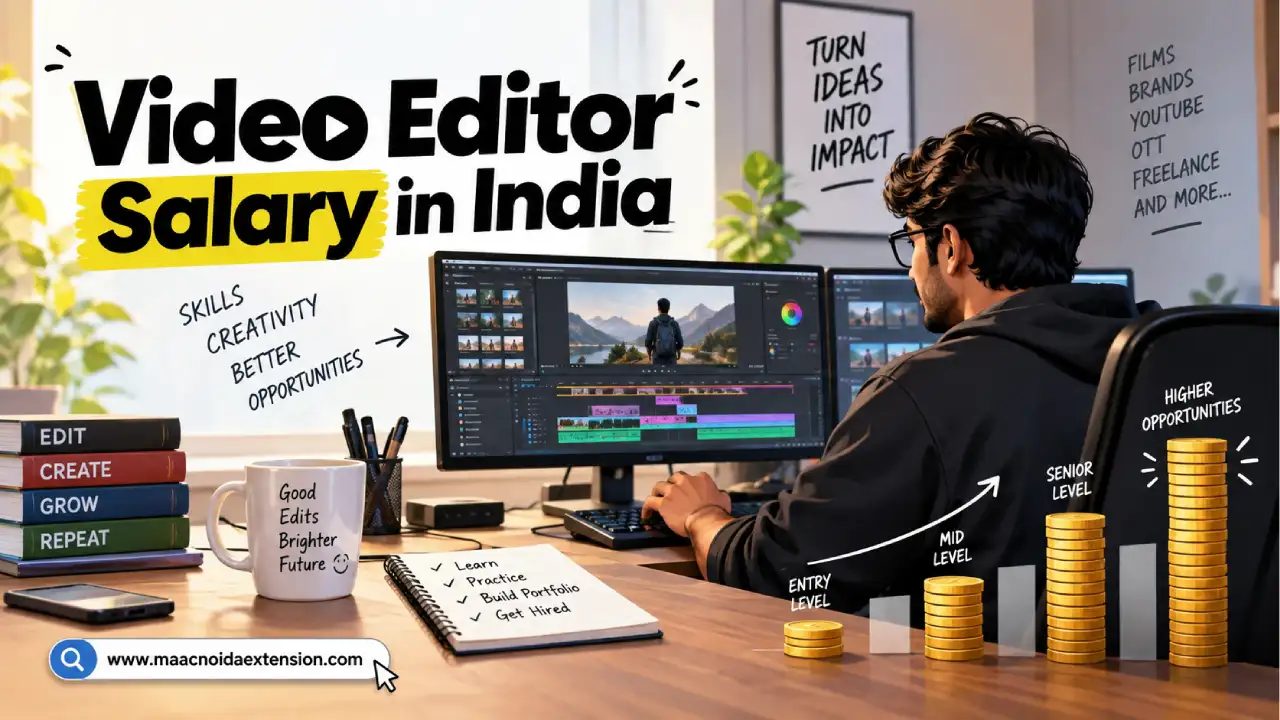
In practical terms, an interview for a junior editing role usually runs like this. They open your portfolio link. They watch twenty to forty seconds. If something holds them, they ask what you did on that project and how long it took. Certificates come up rarely, and usually only in the HR round. Pay at that stage sits in a fairly narrow band anyway, with Indeed’s data putting the India average for video editors near ₹18,500 a month, so what you are really competing on is how quickly you reach the second job.
Classroom, online or hybrid: which format suits live project training?
Classroom training suits beginners and anyone who needs deadline pressure from a room full of people. Online works for working professionals and students in smaller cities. Hybrid suits most people, with software learning done online and project reviews done in person.
Format
Works well for
Where it struggles
Classroom
Beginners after 10th or 12th, and anyone who procrastinates alone
Fixed timings, travel time across NCR traffic
Online
Working professionals, students outside Delhi NCR, second-skill learners
Live projects are harder to arrange and reviews feel thinner
Hybrid
Most students, honestly
Needs discipline on the self-study days
If you are a fresher with no portfolio, choose classroom or hybrid. The single biggest reason students quit online courses is that nobody notices when they stop. If your schedule genuinely will not allow it, an online video editing course still works, provided you commit to sourcing two live projects yourself. Students across the region can also check what the video editing course in Delhi NCR covers in classroom mode.
How do you check if a course really includes live projects?
Ask these seven questions before you pay. Get the answers on WhatsApp or email rather than over a counter, because written answers tend to be more careful. Any centre running genuine project work will answer all seven without hesitation.
How many live projects will I personally complete, not the batch as a group? A specific number is a good sign. “Multiple projects” is not a number.
Who is the client on these projects? A named brand, creator or organisation. If the client is the institute itself, ask whether the work actually gets published anywhere.
Which formats will I cover? Push for range: short form, long form, corporate, event. Six Reels is not a portfolio.
Do I own the final files and can I show them publicly? Get this in writing. Some studios restrict it, and you need to know before, not after.
Who reviews my cut, and how many rounds? Ask for the reviewer’s background. An instructor who has never delivered to a client cannot teach you to deliver to one.
What are the lab hours outside class? Editing needs machine time. Two hours a day of lab access matters more than an extra module on the syllabus.
Can I speak to two students from the previous batch? This is the question that separates confident centres from careful ones.
Do not skip question four. I have seen students finish strong projects and then discover they cannot show the work because of a client agreement nobody explained. On fees, ask for a written breakdown of what is included, since software access, lab hours and certification charges are sometimes billed separately. Our note on video editing course fees and inclusions explains how to read those line items.
What should your portfolio look like at the end of the course?
You should end with a 60 to 90 second showreel plus four to six full pieces in different formats, hosted on one page that opens fast on a phone. Add two lines under each project explaining the brief, your role and the turnaround time.
Showreel of 60 to 90 seconds, strongest eight seconds first. Nobody watches a slow logo intro.
Four to six complete pieces, each in a different format. Range beats repetition.
A short note under each: the brief, what you handled, how long it took. Recruiters read these more than you would expect.
One before and after example, particularly for colour or audio rescue work. It shows judgement, not just output.
A Google Drive backup link, because embedded players fail on office wifi more often than you think.
Build the portfolio page in the last month of the course, not after it ends. Students who wait until they finish usually take another two months to get around to it, and that is two months of not earning. If you are planning your path from school, the wider list of creative courses after 12th and the full course options at our Noida Extension centre will help you compare tracks.
Will live projects help you get placed?
Live projects improve your chances at the interview stage because you can answer practical questions with evidence. They do not guarantee a job. Any institute promising guaranteed placement is either redefining the word or not being straight with you.
If motion graphics interests you after the core course, that is the most reliable next step for pay. Most students build it on top of a Premiere Pro video editing course, and those based nearby often add Adobe Premiere Pro training in Noida for extra lab hours. For a broader view of roles and growth, our piece on video editing career scope covers where this leads over five years, and the broadcast course is worth a look if news and live production appeal to you.
What to do next
Shortlist two or three centres, send all seven questions to each, and compare the replies side by side. The differences will be obvious. Then ask to sit in on one class before you decide, which most good centres allow.
If you want to talk through your situation, the counsellors at MAAC Noida Extension will look at whatever work you already have and tell you honestly where the gaps are. You can get in touch with the centre here.
FAQs
What is a video editing course with live projects?
It is a course where you edit real client briefs with real footage and real deadlines during the training itself. You finish with published or client-approved work you can show, rather than only practice exercises on sample files.
Is a video editing course with live projects good for beginners?
Yes, provided the first month covers software fundamentals before projects begin. Beginners who are thrown into client work on day one usually struggle. Look for a course that builds basics first, then moves to live briefs.
How many live projects should a good course include?
Four to six completed projects across different formats is a reasonable benchmark for a course of six months or more. Quality and variety matter more than count. Six near-identical Reels do not make a portfolio.
Can I do a video editing course with live projects after 12th?
Yes. Most students in these batches join right after 12th. No specific stream is required. What helps is basic computer comfort and the willingness to sit with a timeline for long stretches.
Do online video editing courses offer real live projects?
Some do, but arranging genuine client work remotely is harder. If you choose online, plan to source two projects yourself through local businesses or creators. Ask the institute directly how projects are assigned before enrolling.
Which software will I learn in a live project course?
Adobe Premiere Pro for editing, After Effects for motion graphics, and usually DaVinci Resolve for colour, along with an audio tool. Premiere Pro is the one most Indian studios and brands run on, so start there.
Himanshu is an SEO and content strategy specialist with 10+ years of hands-on experience in Technical SEO, primarily within the EdTech industry. At MAAC Noida Extension, he focuses on building search-first content that connects students with the right career opportunities in animation, VFX, filmmaking, and design.