When I first heard about a graphic design course for beginners, I had one big worry. I thought, “I have never designed anything in my life. I cannot even draw a straight line. Is this course even for me?” The answer is yes. And by the end of this article, you will understand why.
Graphic design courses for beginners are made for people who know nothing about design. That is the whole point. You are not expected to walk in with skills. You are expected to walk out with them.
This blog is written for you — a student sitting at home after 12th, or someone who just finished graduation and is wondering what to do next. I am going to answer every question you probably have right now. Fees, software, how long it takes, what job you can get. Simple and straight.
What Is Graphic Design — And Why Should You Learn It?
Okay, let me explain graphic design basics for beginners in the simplest way. Look at any company’s logo. The poster outside a shop. The packaging on your favourite biscuit. The Instagram ad that just appeared on your phone. Someone made all of that. That someone is a graphic designer.
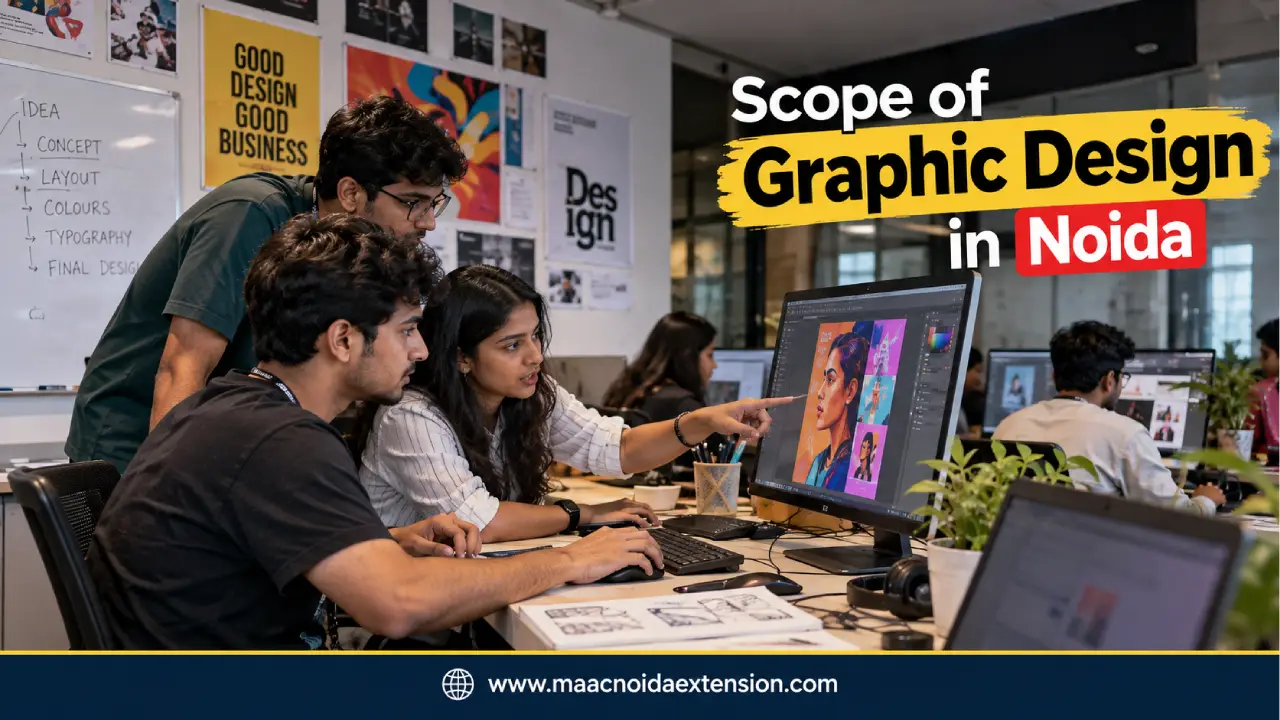
Graphic designers decide how things look — what colours, what fonts, what layout. They work for companies, ad agencies, YouTube channels, startups, and even for themselves as freelancers. And they get paid to do creative work from a computer.
The best part? You do not need to be an artist. You do not need to know how to draw. You do not need a Science or Commerce background. You just need to be interested in how things look — and be willing to learn the tools.
If you are someone who notices when a poster looks ugly, or when a logo looks too crowded, or when a colour combination just feels wrong — you already have the eye for this. The course will teach you the rest.
What Kind of Graphic Design Course Should You Pick?
There are different types of graphic design courses available. Here is a simple comparison so you can figure out which one suits your situation best.
Course Type
Duration
Approx. Fees*
Right for You If…
Short-Term Certificate
3-6 months
Rs.20K-60K
You want to try it quickly first
Diploma Programme
6-12 months
Rs.40K-1.2L
You want a job — this is the sweet spot
Advanced Diploma
1-2 years
Rs.80K-2L
You are serious and want a strong portfolio
Degree (BDes/BVA)
3-4 years
Rs.50K-3L/yr
You want an academic design qualification
Online Self-Paced
1-6 months
Free-Rs.30K
You want to test interest before spending money
* Fees shown are approximate. Always check current fees directly with the institute before deciding.
What Do You Actually Learn in a Beginner Graphic Design Course?
A proper beginner graphic design course teaches you two things together. First, design thinking — why things look good or bad. Second, software skills — how to actually make those things on a computer. Both are equally important. You cannot have one without the other.
Most students get excited about software and ignore design thinking. Big mistake. The students who get jobs are the ones whose work looks like it was thought about — not just made quickly in Photoshop.
The Design Basics Every Beginner Needs to Know First
Before you even open Photoshop, your course will teach you graphic design basics like colour theory, typography, and visual hierarchy. These sound fancy but they are simple ideas. Colour theory is just — which colours look good together. Typography is — how to choose and use fonts properly. Visual hierarchy is — how to make sure people read the most important thing first.
Think about any good poster you have seen. The main message is big and bold. The extra details are smaller. Everything is neatly placed. Nothing feels crowded. That is visual hierarchy at work. You will learn how to do this intentionally.
My advice: Pay full attention during the design principles sessions. Do not rush to the software lab. Students who understand WHY good design looks good will always make better work than students who just know how to use the tools.
Course In Details
Mode / Type
Classroom theory + creative exercises (first 4-6 weeks)
Duration
Part of any full diploma or certificate programme — not a separate course
Approx. Fees*
Included in your full programme fee
Maths Required?
No Maths needed — this is about seeing and thinking visually
Every single beginner — this foundation is what separates average designers from good ones
The Software You Will Learn — And Why It Is Not as Scary as It Looks
Here is the honest truth about software in graphic design training for beginners. Yes, Photoshop and Illustrator look complicated when you first open them. There are too many buttons. Too many panels. But within 3-4 weeks of daily practice, it starts to make sense. And by month two, you will be working in it without thinking.
Most students say the same thing — “I was terrified of Photoshop before I started. Now I use it every day like it is WhatsApp.” That is genuinely how it works. The fear is normal. The familiarity comes fast.
Start with Canva. It is free and very easy. Make a few social media posts with it before your course starts. Just to get comfortable with the idea of arranging things on a screen. When you then open Photoshop in class, you will at least understand what you are trying to do.
Here is a simple breakdown of the main tools you will use:
Software
What It Actually Does
Where You Will Use It
Scary for Beginners?
Adobe Photoshop
Edit photos, make digital art, create ads
Social media posts, banners, retouching
A little at first — but easy within 3-4 weeks
Adobe Illustrator
Draw logos, icons, vector art
Logo design, brand identity, print work
Gets easy once Photoshop clicks for you
Adobe InDesign
Arrange text and images on pages
Brochures, magazines, packaging labels
Easy if you know Photoshop basics already
Canva
Quick template-based design online
Social media, presentations, simple flyers
Very easy — good starting point for day one
Figma
Design apps and websites visually
App UI design, website layout, wireframes
Easy to open, takes time to master fully
CorelDRAW
Vector design for print and signage
Flex banners, visiting cards, local print jobs
Moderate — very useful in Noida/Ghaziabad market
How Long Does It Take to Learn Graphic Design as a Beginner?
The short answer: 6 months for a job-ready level. That is the honest, real answer. With a good 6 to 12 month diploma, daily software practice, and taking every assignment seriously, you will have the skills AND a portfolio to show employers.
A 3-month certificate will give you the basics. But it will not be enough to get placed at most companies. The portfolio you build in 6-12 months is what opens doors. And you cannot rush a portfolio.
Let me tell you about Meera. She is from Ghaziabad and she joined MAAC Noida Extension’s graphic design programme in early 2025 after finishing her Class 12 Commerce. She had never opened Photoshop in her life. Her first design — a simple poster — looked pretty rough, she admits. By month three, she was making logo designs that her batchmates were actually complimenting. By month seven, during the placement drive, her poster designs got shortlisted. She joined a packaging design company in Noida as a junior graphic designer before her course even officially ended.
What made the difference for Meera? She treated every class assignment like a real job. She stayed back in the lab to practise. She asked her teacher to review her work even when it was not compulsory. That attitude is what creates a strong portfolio — not just the number of months you spend in class.
Can You Do a Graphic Design Course Right After 12th?
Yes, absolutely. Graphic design courses after 12th are open to students from every stream. Arts, Commerce, Science — it does not matter. There is no entrance exam. No specific subjects required. The only thing you need is a Class 12 pass certificate and the willingness to learn.
A lot of students think design is only for people who studied Fine Arts or Drawing in school. That is a misconception. Many of the best designers in India have Commerce or Science backgrounds. Design is a skill you learn, not something you are born with.
The confusion between animation vs engineering after 12th is something many students face. Graphic design is a separate path from both — it is creative work done entirely on a computer, and it is accessible from any Class 12 stream without any entrance test.
Why MAAC Noida Extension Is a Good Place to Start Your Graphic Design Journey
If you are in Noida Extension, Greater Noida, or Ghaziabad, MAAC Noida Extension offers a graphic design course with placement that is structured for beginners. The labs have licensed Adobe software. The faculty have worked in the industry — they are not just theory teachers. And the placement team has connections with design agencies, packaging companies, and digital marketing firms in the NCR.
What I like about the MAAC approach is that you work on real briefs during the course — not just practice exercises. You design a logo for a mock brand. You make a packaging design for a product. You create a social media campaign. By the time the placement drive happens, you already have a portfolio of work that looks like real projects.
For more context on how graphic design connects to other creative careers, the detailed comparison between Graphic Design and UI/UX Design is worth reading. Both are strong career paths, and understanding the difference will help you decide which direction to take as you advance.
My honest suggestion: Visit MAAC Noida Extension in person. See the lab. Ask to look at the work students made in the last batch. That will tell you more than any brochure.
Students from Noida Extension, Greater Noida, Ghaziabad wanting placement-focused training
Online Graphic Design Course vs Offline — Which One Should You Choose?
Honestly, if your question is “should I do an online graphic design course for beginners or join a classroom?” — my answer depends on where you are in the process. If you are just testing whether you like design, start with free online videos on YouTube. Watch a few Photoshop tutorials. Make something in Canva. See how you feel.
But if you are sure this is what you want to do for a career — go in person. Why? Because online courses do not give you feedback on your specific work. Nobody looks at your poster and tells you what is wrong with it. That feedback is everything in design.
At MAAC, your teacher looks at your work and says: “This font is too heavy for this background. Change it to something lighter.” Or: “Your logo is not readable at small sizes. Simplify it.” That one comment teaches you something no YouTube video can. That is what builds a real designer.
Course In Details
Mode / Type
Online (test interest) vs In-person diploma at MAAC (build career)
Online: Free to Rs.30,000. In-person at MAAC: Verify current fees with institute
Maths Required?
No Maths needed for either format
What You Learn
Online gives basics and software intro. In-person gives full design skills, portfolio, and placement
Best For
Online if you are exploring. MAAC Noida Extension in-person if you want a real design career
Graphic Design Course Fees in India in 2026
Let me be straight with you about graphic design course fees in India. The range is huge. You can find free YouTube courses at one end, and Rs.3 lakh per year degree programmes at the other end. For most beginners who want a job within a year, you do not need either extreme.
A solid diploma programme at a good institute in the NCR region will cost between Rs.40,000 and Rs.1,20,000 total — not per year, total. That is the realistic fee band for programmes that actually get people placed.
The most expensive programme is not automatically the best one. The cheapest one is not automatically a waste. The right question is: does this programme have proper Adobe software in the lab? Do students from this institute get placed? Can I see the portfolio work of previous batches? If yes to all three, the fee is probably worth it.
What Jobs Can You Get After a Graphic Design Course?
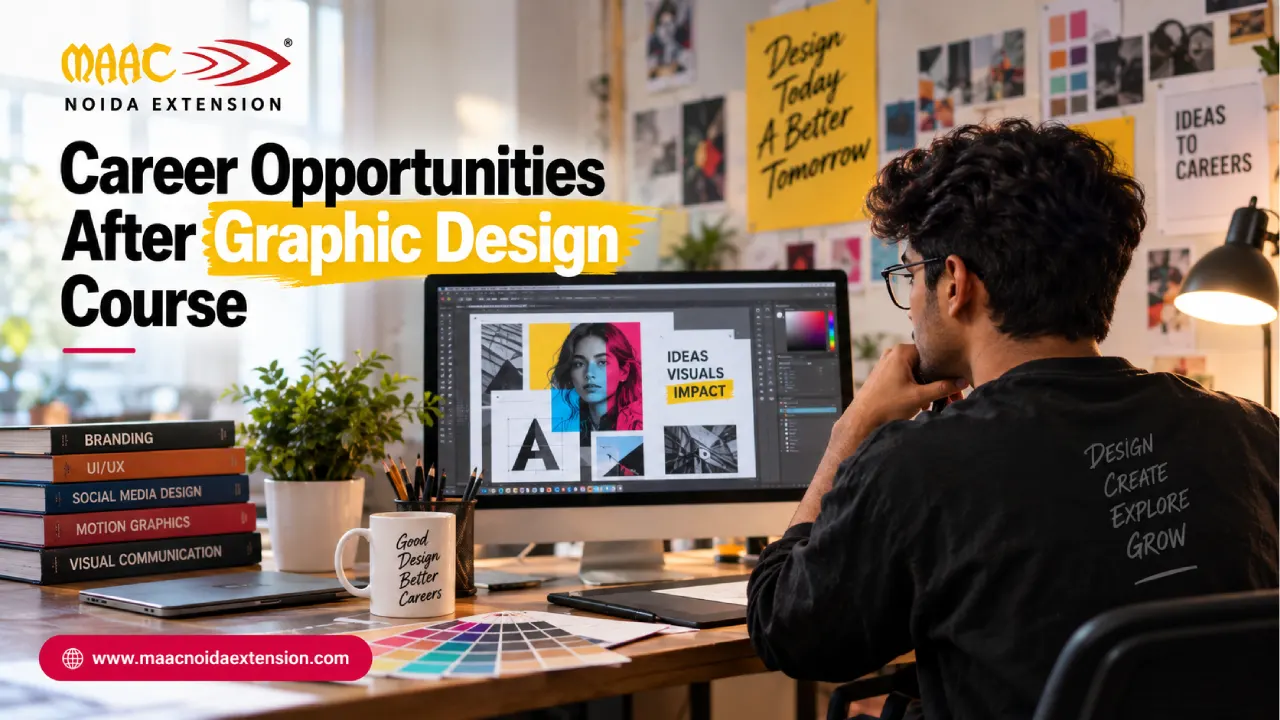
This is the question every student asks first. So let me answer it directly. After a graphic design certification for beginners with a good portfolio, you can apply for jobs like Junior Graphic Designer at a design agency, Social Media Designer at a startup, Packaging Designer at an FMCG company, or Brand Designer at an advertising firm.
You can also freelance. Many graphic designers in India start taking small freelance projects even during their course — visiting card designs, social media posts, small logo jobs. This builds both money and experience at the same time.
Here is a simple plan you can follow right now, even before you join any graphic design course for students:
This week: Watch 2-3 beginner Photoshop videos on YouTube. Just to see what the software looks like.
Next: Go to Canva (free online tool). Make a simple birthday poster or social media post. See if you enjoy the process.
If you like it: Visit MAAC Noida Extension in person. See the lab, meet a faculty member, ask about the programme.
Ask the right questions: “Where did the last batch get placed?” and “Can I see student work from month three?” These tell you everything.
Enrol and commit: Once you are in, treat every assignment seriously. Every brief is portfolio material.
Build your portfolio: Select your 4-6 best pieces from the course. These go to every interview.
Apply while you are still studying: Small freelance jobs, internships, and studio visits during the course build real-world experience.
For a wider view of where graphic design fits in the creative industry, it helps to understand the bigger picture. Animation careers in India and the scope of animation and VFX in India show the industries that graphic designers often work alongside — which can open your mind to career paths you might not have considered yet.
If you are curious about VFX as an alternative or addition to graphic design, a complete guide to VFX careers in India explains the field clearly. And if video editing sounds interesting alongside design, video editing career scope in India is a good read. Many designers pick up video editing as a second skill, since both use the Adobe Creative Suite.
Final Take
I want to tell you one honest thing. When you start a graphic design course for beginners, your first few designs will look bad. Not a little bad. Probably quite bad. This is completely normal and it happens to everyone. The students who end up getting placed are not the ones who were naturally talented from day one. They are the ones who kept going past that uncomfortable first stage.
So here is my simple advice. If graphic design genuinely interests you — even a little — take the first step. Watch some videos this week. Make something in Canva. Visit MAAC Noida Extension and talk to the faculty. See the lab. Look at what previous students made. If it all feels right, enrol.
Can I join a graphic design course with zero experience?
Yes, absolutely. Graphic design courses for beginners are specifically made for people with zero experience. The course starts from scratch — basic design concepts, then software. You do not need any prior skills. Just the interest and the willingness to practise.
How long will it take me to get a job after a graphic design course?
Most students get placed within 1-3 months after completing a 6 to 12 month diploma — if they have a strong portfolio. The portfolio is what decides the timeline, not the certificate. The stronger your 4-6 best pieces, the faster you get placed.
Do I need to know Maths for a graphic design course?
No. There is no Maths in graphic design courses. It does not matter which subject you studied in Class 11-12. The skills you learn are about visual thinking, colours, fonts, and layout — none of which involve Maths.
How much does a graphic design course cost in Noida or Greater Noida?
A diploma programme in the NCR region typically costs between Rs.40,000 and Rs.1,20,000 in total. Verify current fees directly with MAAC Noida Extension. Fees change between batches and the most current information is always at the institute.
What software will I learn in the course?
You will mainly learn Adobe Photoshop, Adobe Illustrator, and CorelDRAW. Most programmes also include Adobe InDesign and Canva. These are the industry-standard tools that companies and clients actually use — and they are exactly what you will work with after placement.
Is an online graphic design course enough to get a job?
Online courses are good for exploring and learning basics. But to get placed at a real company, you need a strong portfolio with feedback from an experienced instructor. In-person diploma programmes at institutes like MAAC Noida Extension build that portfolio systematically.
Himanshu is an SEO and content strategy specialist with 10+ years of hands-on experience in Technical SEO, primarily within the EdTech industry. At MAAC Noida Extension, he focuses on building search-first content that connects students with the right career opportunities in animation, VFX, filmmaking, and design.