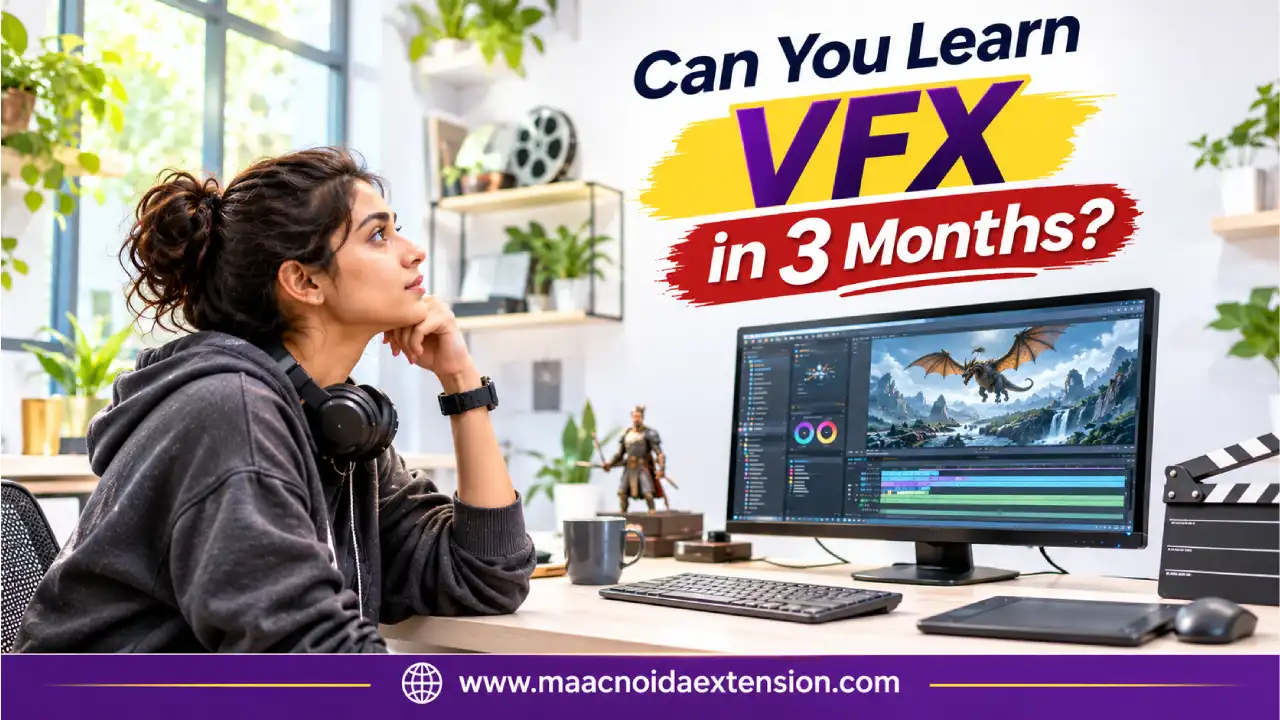
You can learn VFX in 3 months well enough to handle beginner work: green screen keying, basic motion graphics, simple rotoscoping and clean compositing in After Effects. Studio-level compositing in Nuke takes longer, and at MAAC Noida Extension it is part of the 9-month programme. A 3-month VFX course suits video editors, YouTubers and students who want to test whether visual effects is the right field before committing to a longer course.
At our MAAC Noida Extension centre near Gaur Chowk in Greater Noida West, parents usually ask “Will he get a job in 3 months?” while students ask “Can I make film effects by then?” The two questions have different answers.
Yes, you can learn the fundamentals of VFX in three months, even if you have no previous experience. During this period, you can understand how visual effects work, learn the basics of After Effects and practise techniques such as green screen removal, simple tracking and basic compositing.
You may also be able to create a few short projects for your portfolio or demo reel.
But there’s a difference between learning how to create an effect and being able to handle professional studio work.
For example, rotoscoping involves carefully separating moving objects or people from their backgrounds, often frame by frame. Clean results take time, patience and plenty of practice. Professional compositing also requires a deeper understanding of tracking, colour matching and different software tools.
There’s a useful benchmark to consider here. The National Qualifications Register lists the Roto Artist qualification at NSQF Level 4 with 450 hours of training. This includes 150 hours of theory, 240 hours of practical work and 60 hours of on-the-job training.
Now compare that with a typical part-time three-month course.
At our MAAC Noida Extension centre, classes run for two hours per session, either three weekdays or two weekend days per week. Over 12 weeks, that works out to approximately 50–70 classroom hours.
That’s quite a difference from the 450-hour benchmark.
It doesn’t mean you cannot learn VFX in three months. It simply means classroom training alone won’t be enough. You’ll need to spend time practising at home as well. If you can manage another two hours of practice every day, you’ll get much more out of your training.
What can you learn in 3 months of VFX training?
A three-month VFX course generally starts with the basics and gradually introduces practical effects. At MAAC Noida Extension, our three-month Fast Track covers VFX and editing fundamentals, essential motion graphics, green screen techniques and mini projects.
Here’s how the learning process is generally divided.
Month 1: Understanding Footage, Layers and Timelines
The first month is about getting comfortable with the tools and understanding how video editing and visual effects work.
You’ll learn how video is made up of individual frames, how layers work in After Effects and how to create clean edits using Premiere Pro.
You’ll also get introduced to basic image clean-up in Photoshop. For example, removing unwanted objects or wires from a still frame helps you understand how small corrections can improve the final visual.
Month 2: Green Screen and Motion Graphics
Once you’re comfortable with the basic tools, you’ll start working on effects that are more visible.
Green screen keying is one of the first techniques you’ll practise. It involves removing a green background from footage and placing the subject into a different scene.
But simply removing the background isn’t enough. You’ll also need to work on matching the lighting and colours so that the subject doesn’t look out of place in the new environment.
Alongside this, you’ll learn basic motion graphics, including animated titles and simple infographics. These skills are useful in advertisements, social media videos and other short-form content.
Month 3: Basic Tracking, Rotoscoping and a Mini Project
The final month introduces you to more practical VFX work.
You’ll practise basic tracking, which allows you to attach text or images to moving footage. You’ll also get an introduction to simple rotoscoping, where you isolate a moving object or person from the background.
You’ll then bring your learning together in a mini project. This project can become the first shot in your VFX demo reel.
At MAAC Noida Extension, advanced compositing and rotoscoping are covered in the six-month track, while Nuke and Mocha training are part of the nine-month programme.
Which VFX Course Duration Should You Choose?
Not everyone needs to enrol in a long-term VFX programme straight away. The right course depends on your existing skills and what you want to do after completing the training.
For example, a video editor who wants to add visual effects to existing projects may benefit from a three-month course. On the other hand, someone planning to apply for a VFX studio position will need more comprehensive training.
Here’s a quick comparison:
Course Option
What You’ll Learn
Who Should Consider It
Possible Next Step
3-Month Fast Track
VFX basics, green screen keying and motion graphics
Beginners, video editors and YouTubers
Six-month training or freelance work
6-Month Professional
Compositing, rotoscoping and camera tracking
Students interested in junior VFX roles
Advanced training
9-Month Advanced
Nuke, Mocha and VFX techniques for films and advertisements
Students preparing for studio jobs
Portfolio development and job applications
Full Career Programme (12–18 Months)
Complete VFX pipeline and live projects
Class 12 pass students planning a career in VFX
Entry-level studio opportunities
Free Online Tutorials
Individual effects and basic techniques, with limited feedback
Self-disciplined learners
Structured professional training
At MAAC Noida Extension, shorter certifications start from ₹25,000, while full career programmes can go up to ₹4,00,000. The exact fee depends on the programme you choose.
You can explore the course modules on our VFX course page. Before enrolling, ask for the fee of your preferred track and confirm whether GST is included.
One more thing worth checking is the course syllabus. The MESC Roto Artist qualification pack (MES/Q3504) outlines the tasks expected from a junior roto artist. It can be a useful reference when comparing what different institutes teach.
If you’re planning to build a career in VFX rather than just learn a few effects, look for a programme that includes advanced practical training and, where available, internship opportunities.
Which software do you learn in a 3 month VFX course?
A 3 month VFX course mostly uses Adobe After Effects, with Premiere Pro for editing, Photoshop for frame clean-up and Audition for basic sound. These four tools cover keying, motion graphics and simple compositing. Nuke, Mocha Pro and Blender appear in longer programmes.
Learn After Effects properly before you chase Nuke. Layers, masks and keyframes work the same way in Nuke, and most beginner freelance work runs on After Effects anyway. If you already know Premiere Pro from a video editing course in Noida, you can spend more of your three months on effects. For your own 3D elements, add Blender later through our 3D animation programme.
What jobs can you get after a 3 month VFX course?
After a 3 month VFX course, realistic first jobs are video editor with VFX skills, motion graphics artist, and freelance VFX work for YouTubers, wedding studios and local advertisers. Junior roto artist roles become possible with steady practice, though studio roto tests usually expect more than three months of skill.
According to AmbitionBox, video editors in India report ₹1 lakh to ₹6.6 lakh a year (March 2025) and motion graphics designers ₹1.8 lakh to ₹9.8 lakh (March 2025). VFX roto artists report ₹1.2 lakh to ₹6 lakh (July 2025), and VFX compositors ₹1 lakh to ₹7.4 lakh (March 2025). Freshers start near the bottom of these ranges, so verify current figures at AmbitionBox before acting.
How should you plan a 3 month VFX course to get results?
Joining a course is only one part of learning VFX. What you do between classes matters just as much.
If you want to make proper use of your three months, try following this routine from the beginning:
Check your system requirements: Make sure your laptop or computer can run After Effects smoothly. If your system isn’t powerful enough, check the facilities available in your institute’s lab.
Practise every day: Try to spend at least two hours practising outside your regular class sessions.
Recreate existing effects: Choose one effect from a film, advertisement or online video and try to recreate it every week.
Save your work: Keep all your completed projects and practice shots in one folder. These will help you build your portfolio.
Create a demo reel: Use the final two weeks to put together a short reel of around 30–60 seconds.
Get feedback: Show your work to your trainer, understand where you need improvement and discuss which course level you should consider next.
You don’t need to create a complicated film sequence in three months. A few clean, well-executed shots can be more useful than a collection of unfinished projects.
The Final Thoughts
Before you pay for any 3 month VFX course, follow one free After Effects tutorial on green screen keying at home this week. If you enjoy spending an hour fixing the edges on a single shot, VFX will suit you. If that hour feels like a chore, motion graphics or editing may be a better fit.
When you are ready, visit MAAC Noida Extension near Gaur Chowk, Greater Noida West, and sit in on a demo class. Our counsellors will look at what you already know and suggest the 3, 6 or 9 month track that fits. Fill in the course enquiry form or call +91 7011 098 633 to book a visit.
Can I learn VFX in 3 months without any experience?
Yes. You don’t need previous experience to start learning VFX. Beginner courses generally start with video fundamentals and After Effects before moving on to practical effects. However, you’ll need to practise regularly outside your classroom sessions to improve.
Is a 3-month VFX course enough to get a job?
It can help you start taking up freelance projects or apply for video editing roles where basic VFX skills are useful. However, professional studio positions in rotoscoping and compositing generally require more advanced skills, practical experience and a stronger demo reel.
What is the fee for a 3-month VFX course?
At MAAC Noida Extension, shorter VFX certifications start from ₹25,000. The exact fee for a three-month programme depends on the selected course. Contact the centre to confirm the current fee and whether GST is included.
Which software is taught in a 3-month VFX course?
Beginner-level VFX courses generally focus on Adobe After Effects, along with Premiere Pro, Photoshop and Audition. Advanced tools such as Nuke, Mocha Pro and Blender are usually covered in longer programmes.
What is the salary after a VFX course in India?
Salary depends on your job role, practical skills and experience. AmbitionBox reported annual salary ranges of ₹1 lakh to ₹7.4 lakh for VFX compositors (March 2025) and ₹1.2 lakh to ₹6 lakh for VFX roto artists (July 2025). Freshers generally start closer to the lower end of these ranges.
Himanshu is an SEO and content strategy specialist with 10+ years of hands-on experience in Technical SEO, primarily within the EdTech industry. At MAAC Noida Extension, he focuses on building search-first content that connects students with the right career opportunities in animation, VFX, filmmaking, and design.