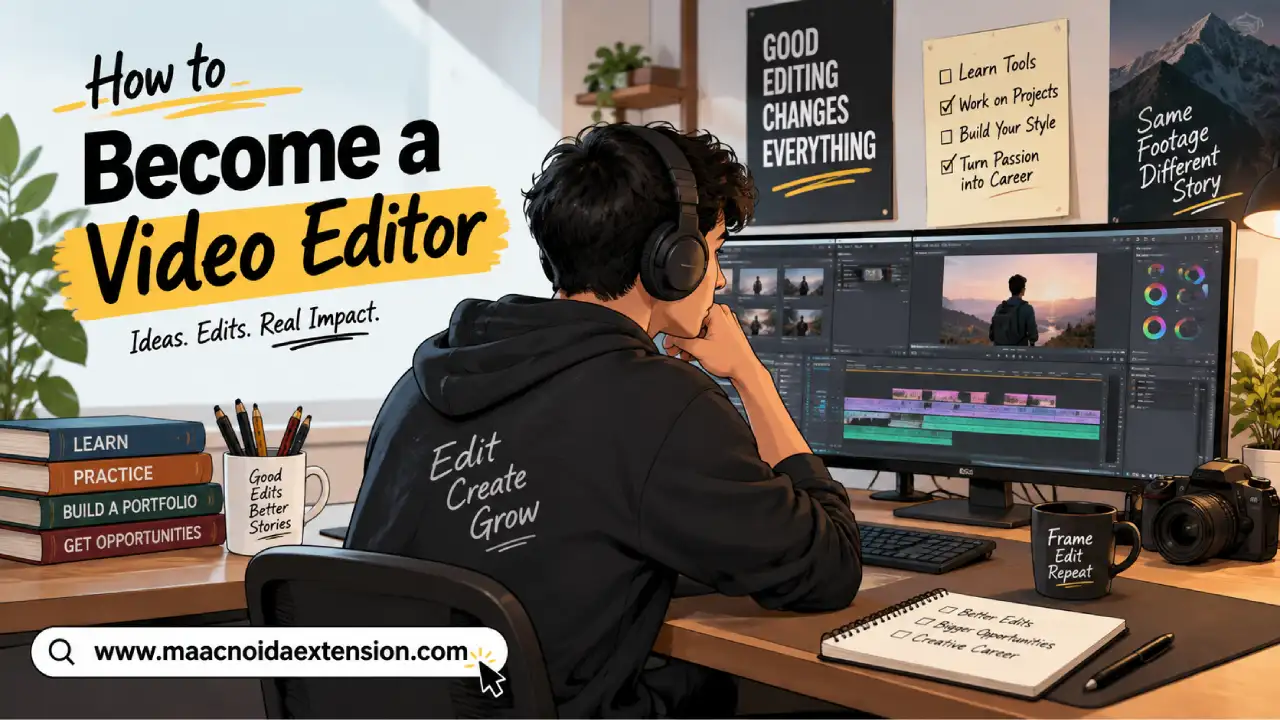
To become a video editor, learn one professional editing software properly, finish a structured video editing course, and build a portfolio of five to eight completed edits. In India you do not need a formal degree for private jobs. Agencies, wedding studios and post production teams in Delhi NCR hire on the strength of your reel and your delivery record. Government roles are the exception and usually ask for a graduate degree along with a recognised editing diploma.
What does a video editor actually do in a working day?
A video editor turns raw footage into a finished video. The work covers importing and organising clips, selecting takes, cutting for rhythm, syncing audio, correcting colour, adding titles and exporting to the format a client asks for. Most of the day goes into reviewing footage, not adding effects.
Spend your first month on organising and cutting only, with no transitions and no presets. We regularly see students who begin with effects struggle a month later, when a Noida agency asks for a plain ninety-second corporate cut. Our blog to how far a video editing career can go covers the senior roles that open later.
How to become a video editor after 12th, step by step
Anyone who has passed Class 12 can start video editing training immediately. There is no entrance exam, and science, commerce and arts students sit in the same batch.
Pick one editing software and stay with it for at least three months.
Join a structured course with lab hours, deadlines and faculty review of your cuts.
Edit fresh footage weekly instead of only the practice files your trainer supplies.
Assemble five to eight finished edits in different formats for your portfolio.
Apply to agencies, wedding studios and YouTube channels for junior editing work.
Re-cut one old project every month using the feedback you received.
A situation we see often at our video editing course in Noida Extension: a B.Com student from a tier 2 town in western Uttar Pradesh joined after repeated rejections from Noida agencies, because her reel held only vertical social clips. She re-cut two old shoots into a ninety-second brand film and a three-minute event recap, and the callbacks began.
Which video editing skills do employers check first?
Employers in Delhi and Noida check five things before your software list.
Cut timing: whether the edit holds attention with the music muted.
Audio: clean dialogue and matched levels between clips.
Colour: consistent skin tones across shots taken on different cameras.
Deadline behaviour: whether the rough cut arrives on the day you promised it.
Fix audio before you touch colour. A beautifully graded video with muddy dialogue gets rejected faster than a flat one that sounds clean. Mute an old edit and see whether the cuts still make sense.
Which video editing courses should you pick after 12th?
A ten to twelve month diploma in video editing and post production is the strongest choice after Class 12, because it gives lab time, deadlines and faculty review that free tutorials cannot. Short certificates work if you already edit and only need software depth. A degree makes sense if you also want direction or production work.
Option
Who it suits
Time required
What to verify
Short certificate course
Students who already cut basic timelines
3 to 6 months
Lab hours, software version, faculty background
Diploma in video editing and post production
Class 12 pass students starting from zero
10 to 12 months
Portfolio review, batch size, placement support terms
Degree in mass communication or film
Students who also want direction or production work
3 years
University affiliation, editing lab access, internship record
Self-learning through free tutorials
Working students with strong self-discipline
6 to 18 months
Whether anyone will give honest feedback on your cuts
Compare the fee against contact hours, not duration, because two institutes quoting the same fee can differ by a hundred lab hours. Our breakdown of what a video editing course costs in India explains what the fee should cover. The Indian Institute of Creative Technologies in Mumbai, backed by the Ministry of Information and Broadcasting, opened its first batch in August 2025 with four post production courses (Press Information Bureau, July 2025).
Which video editing software should you learn first?
Learn Adobe Premiere Pro first. Most agency, television and OTT post production teams in Delhi NCR run Premiere Pro projects, so your files and habits transfer directly. • Adobe Premiere Pro: the default for agency and broadcast editing in India. • DaVinci Resolve: the free version is capable, and its colour tools are the industry reference. • Adobe After Effects: motion graphics and titles, learnt after you can cut confidently. • CapCut: fast vertical edits for brands and creators, never enough on its own. Do not open After Effects until you can finish a five-minute edit in Premiere Pro without help. Our Premiere Pro training with a full syllabus shows the order we teach these tools in, and learning video editing online with a certificate covers the remote format.
How much does a video editor earn in India?
The figures below come only from official recruitment notifications. A Prasar Bharati notification issued in July 2026 invited applications for seven Video Post Production Assistant and Video Editor posts at DD India, New Delhi, offering negotiable consolidated remuneration of up to Rs 50,000 per month on a one-year contract. The same notification asked for a graduate degree, a professional diploma in film and video editing, and three years of relevant experience.
Private pay varies too much by city and client for one number to be honest. Verify current figures at the National Career Service portal (ncs.gov.in), run by the Ministry of Labour and Employment, before acting on any salary claim, and read notifications on the recruiting body website rather than an aggregator.
Freelance work is priced per deliverable rather than per hour. A student from Meerut who quoted an hourly rate for a wedding film ended up doing four unpaid revision rounds, because the client kept changing the song. Quote a fixed price for a fixed number of revisions, in writing. The AVGC-XR Promotion Task Force set up by the Ministry of Information and Broadcasting in 2022 projected around 20 lakh direct and indirect jobs across animation, VFX, gaming, comics and extended reality over a decade, and post production sits inside that count. Our page on video editing classes across Delhi NCR lists what each centre covers.
How do you build a video editing portfolio with no client work?
Use one set of raw footage and deliver three different edits from it. Take a single set of rushes, then cut a thirty-second advertisement, a ninety-second brand film and a fifteen-second vertical from the same material.
Very few beginner reels do this, and it proves format range faster than three unrelated projects. Add a two-line note under each cut explaining the brief you set yourself.
A Class 12 pass student from Greater Noida West had learnt Premiere Pro well but had never matched colour across cameras. His first paid wedding job used three cameras with different white balance, and the client rejected the cut. He picked up colour matching in Resolve, redelivered, and put the before and after comparison in his portfolio, which drew more interview questions than the rest of the reel.
Can you become a video editor without a degree in India?
Yes, for private work. Agencies, wedding studios and YouTube channels in Delhi and Noida hire on portfolio and a short skill test, and many senior editors hold a diploma rather than a degree. Public broadcast roles are stricter: the Prasar Bharati notification above required a graduate degree plus a professional editing diploma.
If you are already enrolled in a degree, finish it and take a video editing course alongside, because evening batches let you build the portfolio in parallel.
What should you do this week to start video editing?
Your first step is smaller than you expect. Download one editing software this week, take twenty minutes of footage from your own phone, and cut it into a clean ninety-second video with matched audio and readable titles. That exercise tells you more about whether editing suits you than any course brochure. Once you know you enjoy it, pick a structured programme with lab hours rather than a video playlist. If you are still comparing fields, our blog to creative courses after 12th sets out the alternatives.
To discuss batch timings, syllabus and fees with our counsellors,send us an enquiryand we will call you back.
FAQs
How long does it take to become a video editor?
Six to twelve months of consistent practice is enough to apply for junior editor roles. Most editors need two to three more years of paid work before handling long-form projects alone.
Can I become a video editor after 12th without any experience?
Yes. Class 12 is the only requirement for most video editing courses in India, and there is no entrance exam. Start with software basics, then build a portfolio.
Which software do professional video editors in India use?
Adobe Premiere Pro dominates agency and broadcast work. DaVinci Resolve is used for colour, After Effects for motion graphics, and CapCut for short vertical content.
Is video editing a good career in India in 2026?
Demand comes from OTT platforms, brands, wedding studios and creators. The AVGC-XR Promotion Task Force set up by the Ministry of Information and Broadcasting in 2022 projected around 20 lakh direct and indirect jobs for the sector over a decade.
Himanshu is an SEO and content strategy specialist with 10+ years of hands-on experience in Technical SEO, primarily within the EdTech industry. At MAAC Noida Extension, he focuses on building search-first content that connects students with the right career opportunities in animation, VFX, filmmaking, and design.