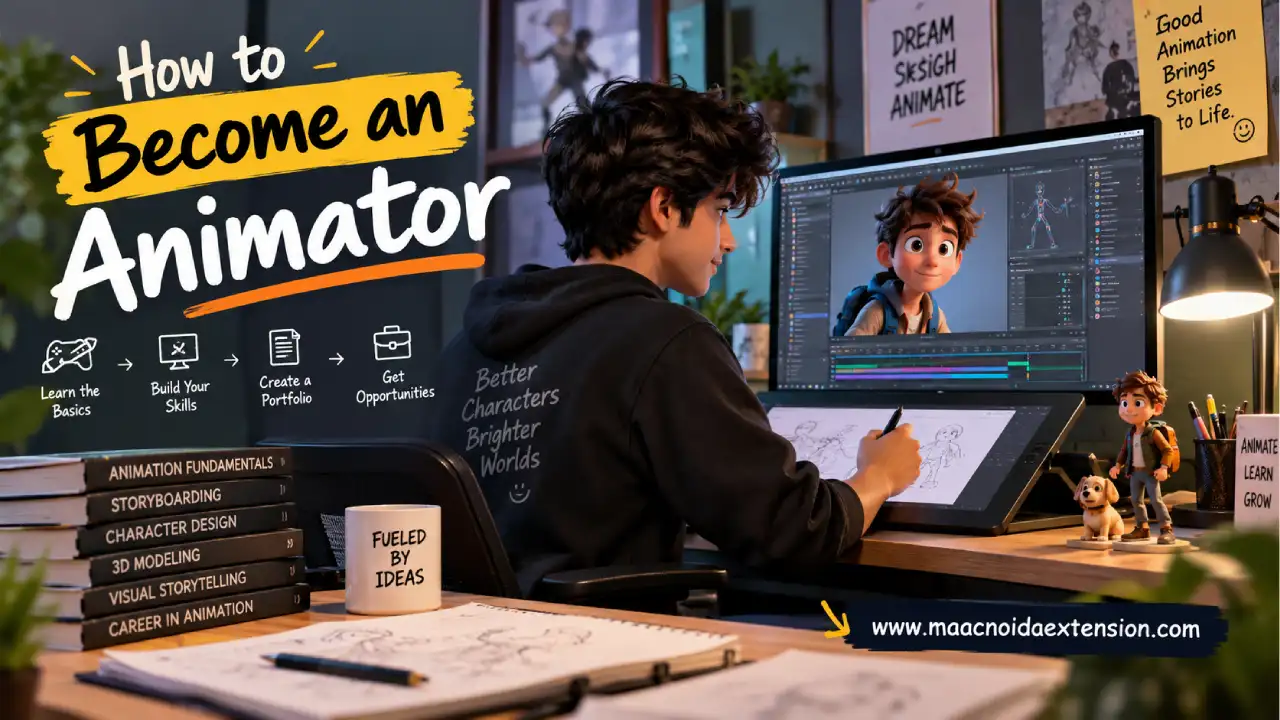
To become an animator, pass Class 12 in any stream, join a specialised animation course, and learn drawing fundamentals along with one 3D software such as Autodesk Maya or Blender. While you study, build a showreel of four to six finished shots. Indian studios hire on the strength of that reel and a short practical test. Entry roles include junior 3D animator, motion graphics artist, rigging artist and layout artist.
An animator creates movement for characters, objects and effects in films, television series, advertisements, games and explainer videos. In an Indian studio the work is shot based. You receive a brief, block the key poses, refine the timing, and submit the shot for review until your supervisor approves it.
Animation is a production job with deadlines and daily reviews. We tell every student joining our 3D animation batches after Class 12 that the first year involves more revision than creation. One student from a CBSE school in Greater Noida West spent three weeks on one walk cycle before the weight looked right, and that repetition cleaned up his blocking later. Our guide to careers in animation explains what each role involves day to day.
Before you pay any fee, sit in on one lab session and watch a shot review happen. If that correction loop interests you rather than irritates you, animation suits you.
How to become an animator after 12th: the step-by-step route
Follow these seven steps in order. Each builds the skill the next one needs.
Complete Class 12 in any stream, since animation admission does not require PCM.
Choose one route: a specialised diploma, a B.Sc in animation, or a B.Des degree.
Spend the first three months on figure drawing, anatomy and the twelve animation principles.
Learn one 3D package properly, usually Autodesk Maya or Blender, before adding another.
Animate weekly exercises: bouncing ball, walk cycle, jump and a short dialogue.
Polish four to six shots and cut them into a reel of 60 to 90 seconds.
Apply to studios with the reel link in your first line, not in an attachment.
Do step three seriously even if you plan to work only in 3D. Students who skip drawing pose characters stiffly, and it shows in every review. If you are still weighing options, read our comparison of animation vs engineering after 12th.
Which animation courses after 12th should you choose?
A specialised animation diploma of 12 to 24 months suits a school-leaver who wants studio work soon. It gives you more software hours and more reviewed shot work than a general degree, which is what studios test at hiring. Pick a B.Sc or B.Des instead if your family or your postgraduate plan needs a recognised degree.
Compare the four common options before you shortlist an institute.
Option
Who it suits
Time required
What to verify
Specialised animation diploma
School-leavers who want studio work quickly
12 to 24 months
Lab hours, faculty studio experience, shots produced per term
B.Sc in animation and multimedia
Students who need a UG degree for PG plans
3 years
University affiliation and scheduled software practice time
B.Des in animation or design
Students clearing design entrance tests
4 years
Entrance criteria, portfolio round, studio infrastructure
Short software course in Maya or After Effects
Freshers adding one specific skill
2 to 4 months
Whether it teaches shot production or only tool menus
Fee is not the deciding factor. Ask how many finished shots you will complete, who reviews them, and how often. Our post on animation courses after 12th breaks down each option, and creative courses after 12th covers wider choices.
What skills are required to become an animator?
Animation skills for beginners fall into two groups: art fundamentals and software. Studios test the first group harder, because software takes weeks to learn while timing sense takes months.
Observation and timing. You must see how a body shifts weight before you can animate it.
Drawing fundamentals, mainly gesture, proportion and perspective for planning poses.
One 3D software at working depth, since Maya and Blender cover most Indian studio requirements.
Basic acting sense, since character animation is performance before it is technique.
Feedback handling and file discipline, because slow revisions and messy versioning hold up the whole team.
Go deep in one area rather than sampling everything. A student from a tier 2 town in western Uttar Pradesh tried character animation, rigging and motion graphics in one term and finished with nothing worth showing. He restarted with body mechanics alone and had four usable shots in five months. If effects work interests you more, our guide on how to become a VFX artist covers that route.
Which animator jobs in India can you apply for after the course?
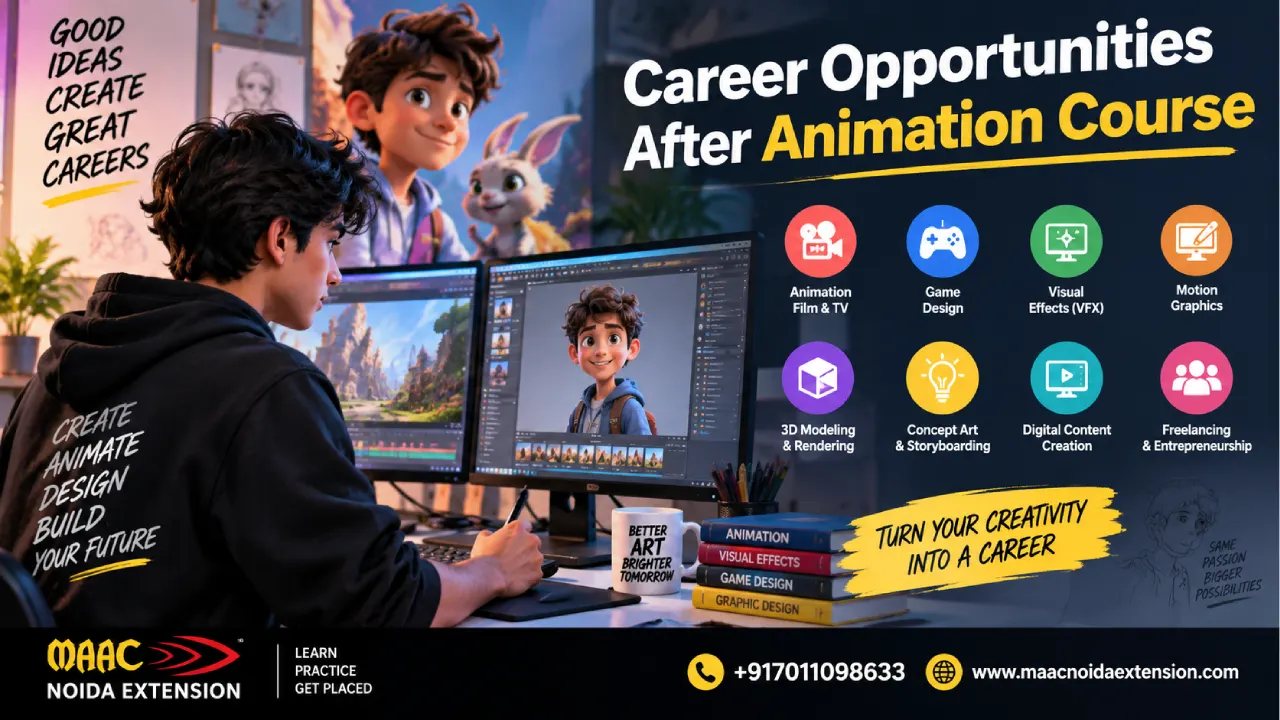
Animator jobs in India sit across studios, advertising agencies, gaming companies, e-learning firms and in-house content teams. A fresher usually starts in one of these roles:
Junior 3D animator, working on character shots under a supervisor.
Motion graphics artist for advertisements, social media and product videos.
Rigging artist, building the controls other animators use.
2D animator for explainer videos and educational media.
Game animator handling loops, attacks and character cycles.
Apply across Delhi NCR before assuming you must move to Mumbai. Noida, Gurugram and West Delhi hire freshers every quarter.
What decides animator salary in India?
Animator salary in India is decided by four things: your specialisation, the quality of your showreel, the type of studio you join, and the city you work in. Character animation and rigging usually pay more than routine motion graphics, because fewer artists do them well.
Freelance income follows a different pattern. Freshers in Delhi NCR usually begin with short explainer videos for small businesses, then raise rates once the reel carries real client work. One student took two unpaid projects for a school YouTube channel, used those shots in his reel, and stopped accepting free work after four months. Choose the specialisation you can practise daily without getting bored, because the reel improves through repetition and the pay follows the reel.
How do you build a showreel that gets you shortlisted?
Your showreel is the actual application. Recruiters at Indian studios often watch the first fifteen seconds and stop, so structure it deliberately.
Open with your strongest shot, never a title card or logo animation.
Keep the total length between 60 and 90 seconds, with no filler shots.
Include one character performance shot and one body mechanics shot at minimum.
Put your name, role and phone number on the first and last frame.
State clearly what you animated in any team or class project.
Send the reel as a link that plays instantly, with two lines above it stating your specialisation and availability. We ask our students to send it to five studios a week from the final term, so rejection arrives while a mentor can still fix the shots.
What should you do in the next 30 days?
Start with one thing this month. Animate a bouncing ball and a walk cycle, then get both reviewed by someone who animates professionally. That single exercise tells you more about your timing sense than any career quiz. Once you know you enjoy the work, shortlist two or three institutes and compare shot output per term rather than fees.
To discuss your options, send us an enquiry or book a center visit at Noida Extension. Bring any drawings or shots you have, and we will tell you which course level fits.
FAQs
Can I become an animator without drawing skills?
Yes. 3D animation depends more on timing, weight and observation than on sketching ability. Drawing still helps you plan poses faster, so improve basic figure drawing alongside software practice in your first term.
How many years does it take to become an animator in India?
A specialised animation diploma takes 12 to 24 months, a B.Sc takes three years and a B.Des takes four. Studio-ready skill arrives once you have four to six polished shots, whichever route you pick.
Which software should a beginner animator learn first?
Start with Autodesk Maya or Blender for 3D animation, or Adobe After Effects for motion graphics. Learn one properly before adding a second, because studios test depth in one package rather than surface knowledge of five.
Can commerce or arts students take animation courses after 12th?
Yes. Animation course eligibility in India is Class 12 pass in any stream. Physics and Maths are not needed for diplomas, B.Sc animation or most B.Des programmes. Design entrance tests check drawing and observation instead.
Do I need a degree to get an animator job in India?
Studios hire on showreel quality and a practical test, so a diploma with strong shots is often enough. A degree matters if you plan postgraduate study, teaching, or applications to companies with fixed education criteria.
Himanshu is an SEO and content strategy specialist with 10+ years of hands-on experience in Technical SEO, primarily within the EdTech industry. At MAAC Noida Extension, he focuses on building search-first content that connects students with the right career opportunities in animation, VFX, filmmaking, and design.